
Hemp Oil vs CBD Oil: What's the Difference?

Key takeaways
- Hemp seed oil is pressed from hemp seeds and carries trace amounts of CBD or THC at most.
- CBD oil is extracted from hemp flowers, leaves and stalks, then mixed into a carrier oil such as MCT.
- A real CBD product lists its CBD in milligrams, such as 1,500mg per bottle.
- "Cannabis sativa seed oil" on an ingredient list means seed oil, not CBD extract.
- In a 2017 JAMA study, only 31% of 84 CBD products sold online matched their label.
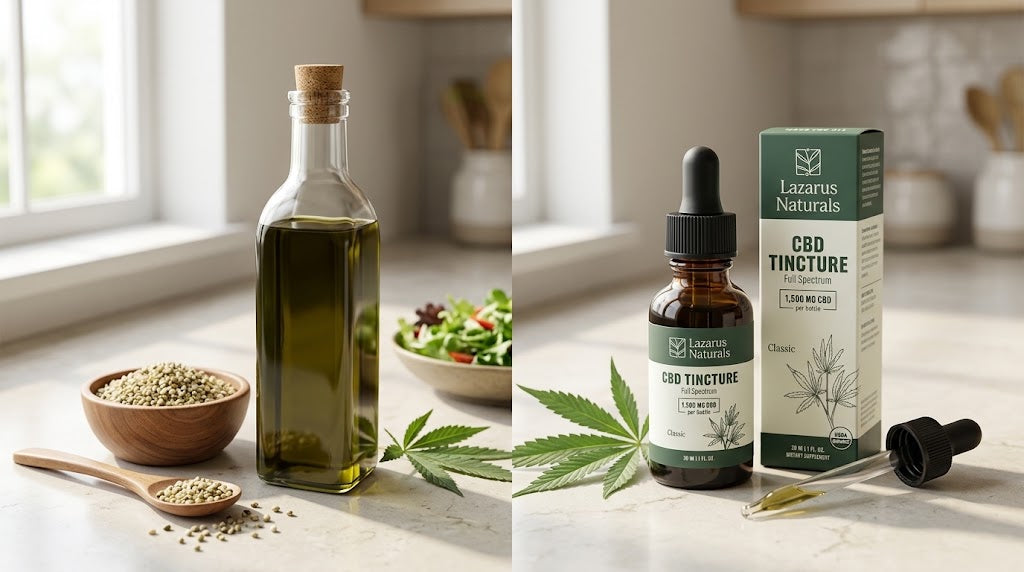
Hemp oil and CBD oil are not the same product. Hemp seed oil is pressed from hemp seeds and contains no CBD. CBD oil is extracted from the flowers, leaves and stalks of the hemp plant, where the cannabinoids actually live. One is a food ingredient. The other is what people are looking for when they shop for CBD.
The confusion is not an accident. Because some marketplaces restrict how CBD can be listed, a lot of sellers label a CBD product as "hemp oil" — and a lot of hemp seed oil gets sold to people who thought they were buying CBD.
In this article
- What hemp seed oil actually is
- What CBD oil actually is
- Side by side
- How to tell them apart on a label
- What about hemp gummies vs CBD gummies?
- Which one do you want?
- Where to start
- Frequently asked questions
What hemp seed oil actually is
Hemp seed oil is cold-pressed from the seeds of the hemp plant, the same way olive oil is pressed from olives. The seeds themselves do not naturally contain THC, according to the FDA. Hemp seed ingredients carry only trace amounts of THC and CBD, picked up from other parts of the plant during harvesting and processing.
What it does contain is fat. More than 80% of hemp seed oil is polyunsaturated fat, mostly omega-6 linoleic acid and omega-3 alpha-linolenic acid, in a ratio of about 2:1 to 3:1 (Callaway, 2004). It also has vitamin E and a nutty flavor that works well in dressings. You will find it in the cooking aisle of health food stores, and in skincare, where it is used as a light carrier oil.
It is a perfectly good product. It is simply not CBD, and no amount of hemp seed oil will give you what a CBD product gives you.
What CBD oil actually is
CBD oil starts with the aerial parts of the plant — flowers, leaves and stalks — where the cannabinoids are concentrated. That plant material goes through an extraction process, usually CO2 or ethanol, and the resulting extract gets blended into a carrier oil so it can be dosed by the dropper.
The carrier is usually MCT oil, sometimes olive oil, and occasionally hemp seed oil. That last one is where a lot of the confusion starts: a CBD tincture can legitimately contain hemp seed oil as its carrier, but the CBD is not coming from the seeds.
The 2018 Farm Bill defined hemp as cannabis with no more than 0.3% delta-9 THC by dry weight. Congress has since rewritten that definition. Starting December 11, 2026, a finished hemp product can contain no more than 0.4mg of total THC per container, according to the Congressional Research Service. State laws also vary.
Side by side
| Hemp seed oil | CBD oil | |
|---|---|---|
| Part of the plant | Seeds | Flowers, leaves, stalks |
| How it is made | Cold-pressed | CO2 or ethanol extraction |
| CBD content | Trace amounts at most | The whole point |
| THC content | Trace amounts at most | Trace amounts in full spectrum; none detected in broad spectrum or isolate |
| Sold as | Food, cosmetic ingredient | Supplement, topical |
| Typical price | Low | Higher, and it varies with potency |
| Lab report needed | Not usually | Yes — always |
How to tell them apart on a label
This is the practical part, and it takes about ten seconds once you know where to look.
Look for milligrams of CBD
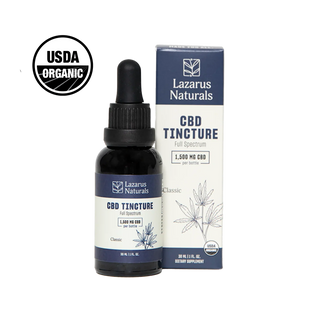
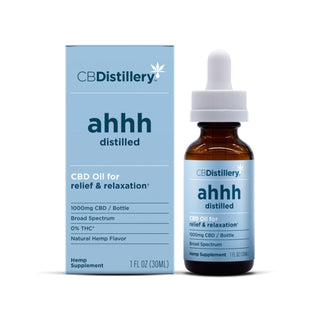
A real CBD product states its cannabinoid content in milligrams — 500mg, 1500mg, 3000mg. Hemp seed oil products state a volume and nothing else. If there is no milligram figure for CBD anywhere on the package, there is probably no CBD in it.
Check the ingredient list
"Cannabis sativa seed oil" means seeds. "Hemp extract," "full spectrum hemp extract," "phytocannabinoid-rich hemp oil" or "cannabidiol" means cannabinoids.
Ask for the Certificate of Analysis
Any CBD product worth buying comes with a batch-specific lab report showing exactly how much CBD, CBG, CBN and THC it contains. Hemp seed oil does not come with one, because there would be nothing to report.
Labels are not always right, which is why the COA matters. When researchers tested 84 CBD products sold online, only 31% contained the amount of CBD printed on the label (JAMA, 2017).
If a seller cannot produce a COA for the batch you are holding, that answers the question for you.
What about hemp gummies vs CBD gummies?
Same trap, different format. "Hemp gummies" is sometimes an accurate description of a CBD product and sometimes a way to sell gummies made with hemp seed oil to people who were shopping for CBD.
The test is identical: look for a milligram figure per gummy, and look for a lab report. A product that says "50mg per gummy" and links to its COA is a CBD product. A product that says "hemp gummies" with no number anywhere is probably not.
Which one do you want?
If you came here after searching for CBD, you want CBD oil. Hemp seed oil is a nutritional product and will not do what you are expecting.
Buy hemp seed oil if you want a cooking oil rich in omega fatty acids, or a light carrier for skincare.
Buy CBD oil if you want cannabinoids — and then the real decisions start: full spectrum, broad spectrum or isolate, how many milligrams, and which format fits your day. Those are worth getting right, and they are covered in our other guides.
Where to start
Everything we carry is CBD or hemp-derived Delta-9, made in the USA, and third-party lab tested with a full-panel Certificate of Analysis. We do not carry synthetic cannabinoids.
- CBD Oils & Tinctures — the classic dropper format
- CBD Gummies — pre-dosed, no measuring
- Capsules & Softgels — same dose every time
- Creams & Balms — applied to the skin
Or shop by what you are after: Sleep, Pain, Wellness, Pets.
Frequently asked questions
Is hemp oil the same as CBD oil?
No. Hemp seed oil is pressed from seeds and contains no CBD. CBD oil is extracted from the flowers, leaves and stalks, where cannabinoids are concentrated. They are different products with different uses and different prices.
Does hemp oil contain CBD?
Hemp seed oil contains no meaningful amount of CBD. However, some sellers label CBD products as "hemp oil" because of marketplace listing restrictions, so the name alone will not tell you. Check for a milligram figure and a lab report.
Why is hemp oil so much cheaper than CBD oil?
Because pressing seeds is far cheaper than extracting and refining cannabinoids from plant material. A large price gap between two similar-looking bottles is usually a sign that one of them is not a CBD product.
Can hemp oil show up on a drug test?
Hemp seed oil carries trace amounts of THC at most, according to the FDA, so it is unlikely to be a concern. Full-spectrum CBD products do contain trace THC that can accumulate with regular use. If you are subject to testing, choose broad-spectrum or isolate and check the batch COA.
Is hemp oil legal everywhere in the US?
Hemp seed oil is sold as a food ingredient across the US. In 2018 the FDA had no questions about hemp seed oil as a food ingredient. CBD products are a separate case: starting December 11, 2026, federal rules limit finished hemp products to 0.4mg of total THC per container, and state laws vary.
Which is better for skin, hemp oil or CBD oil?
They do different things. Hemp seed oil is a light, non-comedogenic carrier oil used widely in cosmetics. CBD topicals deliver cannabinoids to the area where they are applied. Many CBD creams and balms contain both.
Sources
- U.S. Food and Drug Administration. "FDA Responds to Three GRAS Notices for Hemp Seed-Derived Ingredients for Use in Human Food." December 20, 2018. fda.gov
- Callaway JC. "Hempseed as a nutritional resource: An overview." Euphytica. 2004;140:65-72. doi:10.1007/s10681-004-4811-6
- Bonn-Miller MO, Loflin MJE, Thomas BF, Marcu JP, Hyke T, Vandrey R. "Labeling Accuracy of Cannabidiol Extracts Sold Online." JAMA. 2017;318(17):1708-1709. PMID 29114823
- Congressional Research Service. CRS Insight IN12620, on the federal definition of hemp and its 2026 effective dates. congress.gov
