
How to Read a CBD Certificate of Analysis (COA)

Key takeaways
- A COA is a lab report for one batch of a product, from an independent laboratory.
- Check that the lab holds ISO/IEC 17025 accreditation and that the batch number matches your product.
- Lazarus Naturals Classic batch IC51 tested at 51.4mg of CBD per 1mL, against 50mg on the label.
- Federal rules calculate total THC as (0.877 x THCA) + delta-9 THC.
- A full-panel COA also tests for heavy metals, pesticides, residual solvents and microbes.
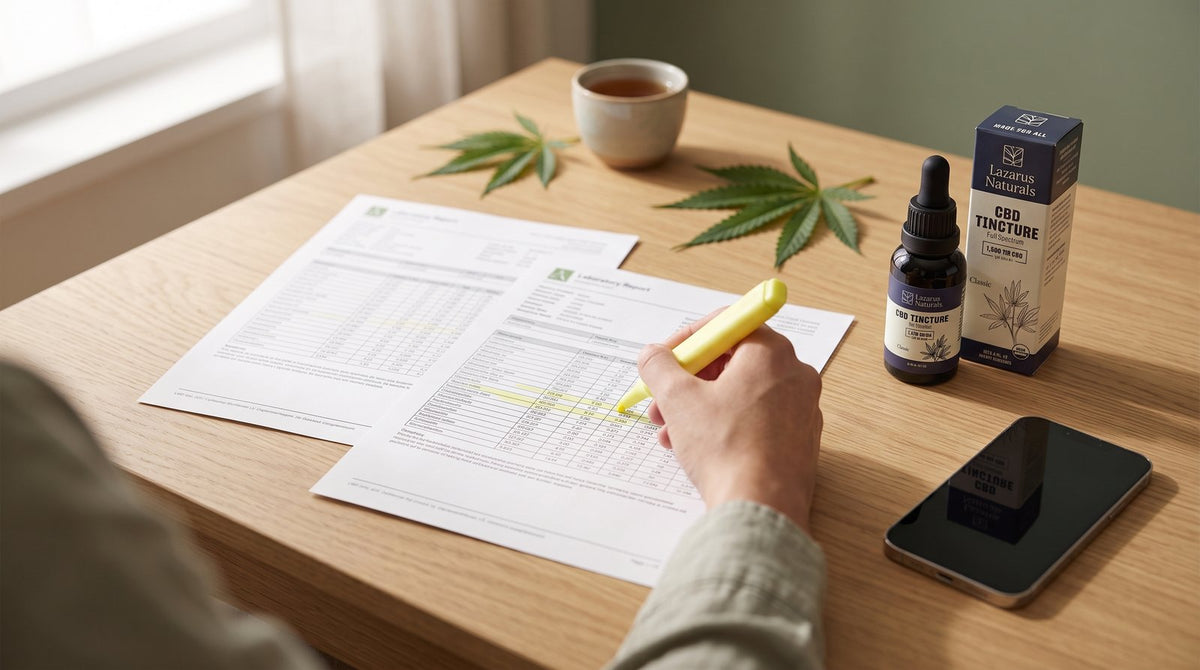
A certificate of analysis, or COA, is a lab report for one batch of a CBD product. You can read one in five checks: who tested it, whether the batch matches your product, how much CBD it holds, how much THC, and whether it passed the contaminant tests. Here is each check on a real report.
In this article
- What is a CBD certificate of analysis?
- Check 1: Who tested it?
- Check 2: Does the batch match your product?
- Check 3: How much CBD is in a serving?
- Check 4: How much THC does it contain?
- Check 5: Did it pass the contaminant tests?
- What are the red flags on a COA?
- COA terms, explained
- Frequently asked questions
What is a CBD certificate of analysis?
A COA is a certified report from an independent, third-party laboratory. It lists what the lab measured in a sample from one production batch. New York's hemp regulations define it exactly that way.
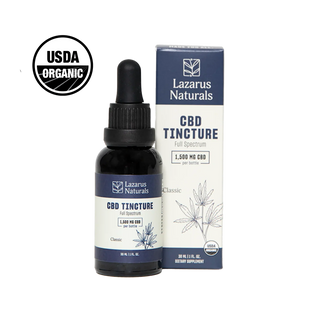
Because it covers one batch, a COA tells you about the bottle you are holding only if the batch numbers match. Our example throughout this guide is the COA for Lazarus Naturals Full Spectrum Classic CBD Oil Tincture, batch IC51.
Check 1: Who tested it?
Look for the lab's name, address and accreditation. The standard to look for is ISO/IEC 17025, the international standard for the competence, impartiality and consistent operation of testing laboratories.
Accreditation comes from an outside body, with a certificate number you can look up. The Lazarus Naturals report states that Anresco Laboratories in San Francisco is ISO/IEC 17025:2017 accredited by ANAB, certificate number AT-1551.

A brand can use more than one lab. Lazarus Naturals lists SC Laboratories Oregon, ORELAP accreditation 4133-012, for the potency results, and Anresco for the safety screens.
Check 2: Does the batch match your product?
Find the batch or lot number on the COA and on your package. They should match. Then check the dates: when the lab received the sample and when it reported the results.

The report above covers lot IC51 of product code TN.O.FS50. The lab received the sample on May 20, 2026 and reported on May 27, 2026. The "Matrix" line tells you what kind of product was tested, here an edible tincture.
Florida's hemp rules require a scannable code on the package that links to the COA for that batch. Many brands outside Florida print one too.
Check 3: How much CBD is in a serving?
Compare the CBD result with the label. The easiest column to read is "per serving," because it uses the same unit as the label. Lazarus Naturals Classic lists 50mg of CBD per 1mL. Batch IC51 tested at 51.4mg per 1mL serving, about 3% above the label.

Labels are often off. A 2017 JAMA study of 84 CBD products sold online found only 31% within 10% of their labeled CBD. A 2024 study of 202 products found that 74% differed from their label by at least 10%.
Some reports give results in mg/g or as a percentage instead. To turn mg/g into a percentage, divide by 10: 55.2mg/g is 5.52%. For an oil, mg/g is close to mg/mL, but not identical, because oil weighs slightly less than water.
Check 4: How much THC does it contain?
Find the line for total THC. Under federal hemp rules (7 CFR 990.1), total THC is calculated as (0.877 x THCA) + delta-9 THC. The 0.877 factor accounts for the weight THCA loses when heat turns it into THC.
In batch IC51, THCA is below the limit of quantitation, so total THC equals the delta-9 THC result: 1.83mg per 1mL serving. Delta-8 THC is also below the limit.
What you should see depends on the spectrum. A full spectrum product like this one shows a small THC result. A broad spectrum or isolate product should show "ND" or "<LOQ" for THC. See full spectrum vs broad spectrum vs isolate.
Check 5: Did it pass the contaminant tests?
A full-panel COA tests for more than cannabinoids. Look for heavy metals, pesticides, residual solvents, microbes and, often, mycotoxins, each with a result and a limit or a pass or fail.

- Heavy metals: arsenic, cadmium, lead and mercury. Batch IC51 shows all four below the limit of quantitation, against action levels of 1.5, 0.5, 0.5 and 3.0 µg/g.
- Residual solvents: traces of the solvents used in extraction, such as ethanol or heptane.
- Pesticides: usually a list of 50 or more. Batch IC51 found none above the regulatory limits.
- Microbes: yeast, mold and bacteria such as E. coli and Salmonella, reported as pass or fail.
These panels matter. A 2022 study of 121 edible CBD products found lead in 42% of them. Florida's rules require COAs for hemp extract to report metals, pesticides, residual solvents, pathogens and mycotoxins.
What are the red flags on a COA?
Walk away, or ask the brand, if you see any of these:
- No lab name, no address or no accreditation number.
- A batch number that does not match your package, or no batch number at all.
- A report dated long before your product could have been made.
- Potency only, with no contaminant panels.
- CBD far from the label, or THC detected in a product sold as THC-free.
- A PDF you cannot verify with the lab, when the lab offers a way to check reports.
A COA is only as useful as its match to your bottle. If the batch or the date does not line up, ask the seller for the report for your batch.
COA terms, explained
| Term | What it means |
|---|---|
| LOD | Limit of detection: the smallest amount the method can detect. |
| LOQ | Limit of quantitation: the smallest amount the method can measure reliably. |
| ND | Not detected: below the limit of detection. |
| <LOQ | Detected or possibly present, but too little to measure reliably. |
| mg/g and % | Concentration by weight. 10mg/g equals 1%. |
| Total THC | (0.877 x THCA) + delta-9 THC. |
| Batch or lot | The production run the sample came from. |
| Matrix | The type of product tested, such as a tincture or a gummy. |
| Action level | The limit a contaminant result is compared against. |
| ISO/IEC 17025 | The international standard for testing laboratories. |
Frequently asked questions
What does ND mean on a COA?
ND means not detected. The compound was below the lowest amount the lab's method can detect. It does not always mean zero.
What is the difference between LOD and LOQ?
The limit of detection is the smallest amount a method can detect. The limit of quantitation is the smallest amount it can measure reliably. A result of "<LOQ" sits between the two or below.
Why does my COA show more CBD than the label?
Batches vary, and so do lab measurements. A small gap is normal: Lazarus Naturals Classic batch IC51 tested at 51.4mg per mL against 50mg on the label, about 3% higher. A gap of more than 10% is worth asking the brand about.
Does every batch get its own COA?
It should. A COA describes one batch, so a new batch needs a new report. Check that the batch number on the report matches your package.
Why is the COA from a different lab than the brand?
That is the point of a third-party COA. The lab is independent from the company that made the product, so it has no stake in the result.
Where do I find the COA for a CBDestiny product?
Open the product page and look for the lab report link. When a product comes in several versions, each version links its own report.
Sources
- International Organization for Standardization. "ISO/IEC 17025:2017 General requirements for the competence of testing and calibration laboratories." iso.org
- New York State Office of Cannabis Management. 9 NYCRR Part 114, Cannabinoid Hemp, sections 114.1 and 114.10. Adopted December 2023. cannabis.ny.gov
- 7 CFR 990.1, Definitions ("Total THC"), USDA Domestic Hemp Production Program. ecfr.gov
- Florida Administrative Code, Rule 5K-4.034, Hemp Extract for Human Consumption. flrules.org
- Bonn-Miller MO, Loflin MJE, Thomas BF, Marcu JP, Hyke T, Vandrey R. "Labeling Accuracy of Cannabidiol Extracts Sold Online." JAMA. 2017;318(17):1708-1709. PMC5818782
- Gidal BE, Vandrey R, Wallin C, et al. "Product labeling accuracy and contamination analysis of commercially available cannabidiol product samples." Frontiers in Pharmacology. 2024;15:1335441. Funded by Jazz Pharmaceuticals. PMC10982813
- Gardener H, Wallin C, Bowen J. "Heavy metal and phthalate contamination and labeling integrity in a large sample of US commercially available cannabidiol (CBD) products." Science of the Total Environment. 2022;851(Pt 1):158110. PMID 35987236
- Lazarus Naturals. Certificate of analysis, CBD Tincture Full Spectrum, batch IC51 (SC Laboratories Oregon and Anresco Laboratories, May 2026). Linked on the product page.