
CBG vs CBD: What's the Difference? (2026 Guide)

Key takeaways
- CBD-type hemp flower averages about 7 to 8% CBD. CBG is usually under 1%.
- Neither CBG nor CBD is intoxicating.
- CBG costs more per milligram because hemp yields so little of it.
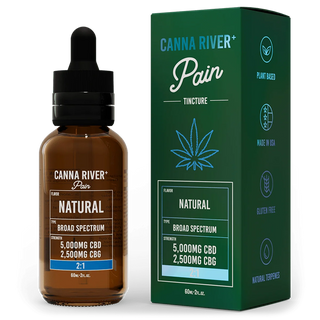
- Most CBG products are blends, such as Canna River Pain CBD + CBG Tincture.
- Research on CBG is mostly preclinical. CBD has been studied in human trials.
CBG and CBD are two different cannabinoids from the same hemp plant. CBD is abundant: CBD-type hemp flower averages about 7 to 8% CBD. CBG is scarce, usually under 1%, because the plant converts most of it into other cannabinoids as it grows. Neither one is intoxicating.
That scarcity explains almost everything else: why CBG costs more, why you rarely see it on its own, and why most CBG products are blends.
In this article
- What is CBG?
- What is CBD?
- The key differences, side by side
- Why CBG costs more
- Why you usually see them together
- How to choose
- What we carry
- Frequently asked questions
What is CBG?
CBG, or cannabigerol, is sometimes called the "mother cannabinoid." The hemp plant produces it first, then converts it into other cannabinoids as it matures. In its acidic form, CBGA is the starting point that the plant's enzymes turn into THCA, CBDA and other acidic cannabinoids. A 2021 review in the Journal of Pharmacology and Experimental Therapeutics describes CBG as the precursor of the most abundant cannabinoids.
By harvest time, most of that original CBGA is gone — converted into something else. That is why most hemp cultivars contain under 1% CBG, according to Cornell University's hemp program, and why a bottle of CBG costs what it does.
CBG is non-intoxicating. It will not produce the high associated with delta-9 THC.
Research on CBG is younger than research on CBD. A 2022 review found that its effects have been shown only in preclinical experiments so far, and that human studies are still needed. Anyone telling you otherwise is getting ahead of the evidence.
What is CBD?
CBD, or cannabidiol, is the cannabinoid hemp produces in quantity. In NC State Extension field trials of 17 hemp cultivars, the flower averaged 7.58% CBD when it reached the federal THC testing limit. That volume makes CBD cheap to extract at scale and easy to find in every format there is: tinctures, gummies, softgels, balms, roll-ons, pet drops.
It is also the most studied cannabinoid after THC. There is even an FDA-approved prescription drug based on it — Epidiolex, for seizures linked to three specific conditions. That approval covers a prescription medication, not the products on our shelf or anyone else's.
The 2018 Farm Bill defined hemp as cannabis with no more than 0.3% delta-9 THC by dry weight. Congress has since rewritten that definition. Starting December 11, 2026, a finished hemp product can contain no more than 0.4mg of total THC per container, according to the Congressional Research Service. State laws also vary.
The key differences, side by side
| CBG | CBD | |
|---|---|---|
| Full name | Cannabigerol | Cannabidiol |
| Amount in mature hemp | Usually under 1% | About 6–8% in CBD-type hemp |
| Role in the plant | Precursor to other cannabinoids | End-stage cannabinoid |
| Intoxicating | No | No |
| Research volume | Early, mostly preclinical | Extensive, includes human trials |
| Relative cost | Higher | Lower |
| Availability | Limited, usually in blends | Wide, every format |
Same plant. Different molecules. Very different availability.
Why CBG costs more
It comes down to yield. To get a usable amount of CBG, a grower has two options: harvest the hemp early, before conversion finishes, or plant specialty high-CBG cultivars that produce less biomass overall. Either way they end up with far less finished cannabinoid per acre than they would extracting CBD.
That is why standalone CBG isolate is rare and why most CBG reaches the shelf as part of a blend. A smaller amount of CBG on a larger CBD base keeps the price reasonable while still delivering a real CBG dose.
One practical warning: if you find a CBG product priced the same as a comparable CBD product, pull up the Certificate of Analysis before you buy. The actual CBG content is often lower than the front of the label suggests.
Why you usually see them together
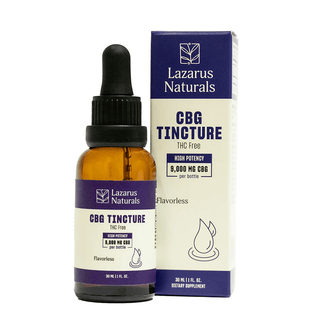
Walk through any CBG selection and you will notice most products are blends. Canna River's Pain tincture pairs CBD with CBG. Its Calm softgels put CBD, CBN, and CBG in one capsule. Lazarus Naturals sells a standalone high-potency CBG tincture, but also a CBD:CBG gummy.
Part of that is cost. Part of it is the entourage effect — the idea that cannabinoids and terpenes may interact and behave differently together than any one of them does alone. It is worth saying plainly that the entourage effect is a working hypothesis in cannabinoid research, not settled science.
Worth knowing: broad-spectrum and full-spectrum products already contain trace amounts of minor cannabinoids like CBG, even when the label does not advertise it. Isolates do not — an isolate is one cannabinoid and nothing else.
How to choose
If you are new to hemp, start with CBD. It is the most researched, the most affordable, and it comes in every format, which makes it far easier to find something that fits how you actually live. Come back to CBG once you have a baseline and want to try a different profile.
Beyond that, three things decide it:
Format
CBD comes as tinctures, gummies, softgels, balms, roll-ons, and pet formulas. CBG is mostly limited to tinctures, softgels, and gummies. If you want something topical, CBD is your answer.
Budget
A 1,500mg CBD tincture and a 1,500mg CBG tincture are not the same purchase. Expect to pay more per milligram for CBG, and compare products on cost per milligram rather than bottle price.
THC tolerance
This one is separate from the CBG-versus-CBD question. Both come in broad-spectrum formulas with no detectable THC and full-spectrum formulas that carry trace THC. If you are subject to drug testing, go broad spectrum or isolate — and read the COA for that specific batch, not the product line.
Whichever you pick, check the lab report. Every product on our shelf carries a full-panel Certificate of Analysis from a third-party lab, tied to its batch.
What we carry
Both, from brands that publish batch-level lab results.
CBG on its own
CBD and CBG together
- Canna River Pain CBD + CBG Tincture — broad spectrum
- Canna River Pain Softgels CBD + CBG
- Canna River Calm Softgels — CBD, CBN and CBG in one capsule
- Canna River Pain Gummies CBD + CBG
CBD on its own
Browse the full CBD collection, or shop by what you are after: Sleep, Pain, Wellness.
Frequently asked questions
Is CBG stronger than CBD?
Not in any way that makes for a clean ranking. They are different molecules that behave differently, so "stronger" is not a useful comparison. CBG is rarer and pricier to produce, but that reflects scarcity, not potency.
Will CBG make me high?
No. Like CBD, CBG is non-intoxicating.
Will CBG show up on a drug test?
Standard tests screen for THC metabolites, not CBG or CBD. That said, full-spectrum products contain trace THC that can build up with regular use. If you are tested, choose broad-spectrum or isolate and check the batch COA.
What is the difference between CBG and CBN?
CBG shows up early, as the plant's precursor cannabinoid. CBN shows up late, as THC degrades with age, oxygen and light. Both are non-intoxicating. You will find CBN mostly in sleep formulas and CBG mostly in daytime products and blends.
Can I take CBG and CBD together?
Yes. Most CBG products are formulated that way already.
How much CBG should I take?
There is no established standard serving. Follow the suggested serving on the label, and talk to your healthcare provider before adding any hemp product to your routine — especially if you take prescription medication.
Sources
- Nachnani R, Raup-Konsavage WM, Vrana KE. "The Pharmacological Case for Cannabigerol." Journal of Pharmacology and Experimental Therapeutics. 2021;376(2):204-212. doi:10.1124/jpet.120.000340
- Cornell University, College of Agriculture and Life Sciences. "2020 CBG Hemp Cultivar Trial." hemp.cals.cornell.edu
- Calapai F, Cardia L, Esposito E, et al. "Pharmacological Aspects and Biological Effects of Cannabigerol and Its Synthetic Derivatives." Evidence-Based Complementary and Alternative Medicine. 2022;2022:3336516. PMC9666035
- Suchoff D, et al. "Understanding the Relationship between THC and CBD in Hemp." NC State Extension, April 29, 2022. content.ces.ncsu.edu
- U.S. Food and Drug Administration. "FDA Regulation of Cannabis and Cannabis-Derived Products, Including Cannabidiol (CBD)." Updated July 16, 2024. fda.gov
- Congressional Research Service. CRS Insight IN12620, on the federal definition of hemp and its 2026 effective dates. congress.gov
